Introduction
I thought that self-hosting email is impossible, but you can actually learn the basics and have a basic usable setup in a day or two. People say that with self-hosting you do risk getting your mail flagged as spam, or worse, dropped. I manually tested my setup with some popular email services for small proof of real-world deliverability. The setup is pretty barebones so I have to do email in an ssh session :)
Postfix
To self-host email you need to open port 25 and install Postfix. Postfix is an SMTP server, but you also need to set up OpenDKIM to get your mail delivered to popular services.
Here's my Postfix config to show how simple it can be. I left the master.cf file as it was, because I’m always submitting email locally. You should also read the comments in the default alias config file.
/etc/postfix/main.cf
compatibility_level = 3.8
mail_owner = postfix

myhostname = mx.idx.cy
mydomain = idx.cy
# Default sender domain
myorigin = idx.cy
# Receive mail at those domains
mydestination = localhost, idx.cy, maxadamski.com, localchat.cc

# Aliases for receiving mail
alias_maps = hash:/etc/aliases
alias_database = $alias_maps
recipient_delimiter = +

# You can assign addresses to Unix users.
# I don't because I'm the only user on my server, and I want to set the From header freely.
#smtpd_sender_login_maps = hash:/etc/postfix/sender_login_maps
#smtpd_sender_restrictions = reject_authenticated_sender_login_mismatch

# Open to the internet
inet_interfaces = all
inet_protocols = ipv4

# Relay control
mynetworks_style = host
smtpd_recipient_restrictions = permit_mynetworks, reject_unauth_destination

# Obfuscation
smtpd_banner = $myhostname ESMTP
disable_vrfy_command = yes

# OpenDKIM
smtpd_milters = inet:localhost:8891
non_smtpd_milters = inet:localhost:8891
milter_default_action = accept

# TLS (encrypt or bust)
smtp_tls_security_level = encrypt
smtpd_tls_security_level = encrypt
smtpd_tls_key_file = /etc/cert/mx.idx.cy.key
smtpd_tls_cert_file = /etc/cert/mx.idx.cy.crt
/etc/postfix/master.cf
# ==========================================================================
# service type  private unpriv  chroot  wakeup  maxproc command + args
#               (yes)   (yes)   (no)    (never) (100)
# ==========================================================================
smtp      inet  n       -       n       -       -       smtpd
pickup    unix  n       -       n       60      1       pickup
cleanup   unix  n       -       n       -       0       cleanup
qmgr      unix  n       -       n       300     1       qmgr
tlsmgr    unix  -       -       n       1000?   1       tlsmgr
rewrite   unix  -       -       n       -       -       trivial-rewrite
bounce    unix  -       -       n       -       0       bounce
defer     unix  -       -       n       -       0       bounce
trace     unix  -       -       n       -       0       bounce
verify    unix  -       -       n       -       1       verify
flush     unix  n       -       n       1000?   0       flush
proxymap  unix  -       -       n       -       -       proxymap
proxywrite unix -       -       n       -       1       proxymap
smtp      unix  -       -       n       -       -       smtp
relay     unix  -       -       n       -       -       smtp
        -o syslog_name=postfix/$service_name
showq     unix  n       -       n       -       -       showq
error     unix  -       -       n       -       -       error
retry     unix  -       -       n       -       -       error
discard   unix  -       -       n       -       -       discard
local     unix  -       n       n       -       -       local
virtual   unix  -       n       n       -       -       virtual
lmtp      unix  -       -       n       -       -       lmtp
anvil     unix  -       -       n       -       1       anvil
scache    unix  -       -       n       -       1       scache
postlog   unix-dgram n  -       n       -       1       postlogd
Notice there's no mention of POP3 or IMAP! I wasted some time trying to set them up with Dovecot (it recently changed the config format, so guides became outdated and the new docs were hard to read). You can receive mail in the terminal, and send it locally with SMTP.
TLS
You need one SSL certificate for your machine to use TLS to encrypt communication between SMTP servers. Create an A record mx.example.com pointing to the IP address of your server and get a free certificate from Let's Encrypt. Then, point to the certificate files in the Postfix configuration, reload, and you’ve encrypted your email trainsport!
Why are no certificates needed for your actual email domains like example.com? TLS is only for securing the connection between servers, and encryption in transit only cares about the server hostnames. You can send mail from any domain by modifying the "From" mail header. However, you need to set up SPF and DKIM to prove domain ownership to other servers.
I highly recommend using acme.sh to generate SSL certificates on your system. Simple, with no extra dependcies.
I'm generating certificates for email (and HTTPS) using acme.sh and Nginx.
# Serve the ACME challenge files over HTTP.
# Redirect everything else to HTTPS.
server {
  listen 80 default_server;
  server_name _;
  location ^~ /.well-known/acme-challenge/ {
    root /www;
    try_files /$host/$uri =404;
  }
  location / {
    return 301 https://$host$request_uri;
  }
}
# Register at Let's Encrypt for free certificates.
acme.sh --set-default-ca --server letsencrypt
acme.sh --register-account -m postmaster@example.com

DOMAIN=mx.example.com

# Issue and copy certs from ~/.acme.sh to /etc/cert and add reloading after automatic renewals.
# You can also issue a multi-domain cert. I did --issue -d idx.cy -d mx.idx.cy for example.
acme.sh --issue -d $DOMAIN -w /www/$DOMAIN
acme.sh --install-cert -d $DOMAIN --key-file /etc/cert/$DOMAIN.key --fullchain-file /etc/cert/$DOMAIN.crt --reloadcmd "nginx -s reload; postfix reload"
acme.sh stores data in ~/.acme.sh directory. It has a clear structure that you can inspect and edit. It remembers your proper certificate directory and what to execute after a reload. You can reissue certificates by running acme.sh --cron. The certificates are valid for 90 days.
Alternatively, you can manually grab a TLS certificate by doing the DNS challenge, where you publish a TXT record with a value that acme.sh tells you.
DNS, DKIM, SPF, and DMARC
You should prove that your emails actually come from your domain to make your mail trustworthy and to deliver to Gmail and co. That’s what DKIM is for, and fortunately it’s a one-time deal per email domain.
First you generate a key pair for each domain with OpenDKIM, and then you publish the public keys as TXT records in DNS.
The keys don’t expire, so it’s good practice to rotate them periodically. My config uses a naming scheme that allows smooth rotation, but it doesn’t complicate things if you skip it.
There are two more TXT records that you need to publish in DNS: the SPF and DMARC records. You say which hosts are allowed to send from your email domain, and give instructions to other email servers about what to do with mail that fails SPF and DKIM checks.
I told them to reject such mail and send reports to a special address. This could alert me of email spoofing attempts.
Take a look at my OpenDKIM config to see how things come together.
/etc/opendkim.conf
UserID             opendkim:opendkim
Socket             inet:8891@localhost
KeyTable           refile:/etc/opendkim/KeyTable
SigningTable       refile:/etc/opendkim/SigningTable
ExternalIgnoreList refile:/etc/opendkim/TrustedHosts
InternalHosts      refile:/etc/opendkim/TrustedHosts

Canonicalization   relaxed/relaxed
ReportAddress      postmaster@idx.cy
SendReports        no

LogWhy             yes
Syslog             yes
SyslogSuccess      no
/etc/opendkim/KeyTable
key1._domainkey.idx.cy         idx.cy:key1:/etc/opendkim/keys/idx.cy/key1.private
key1._domainkey.maxadamski.com maxadamski.com:key1:/etc/opendkim/keys/maxadamski.com/key1.private
key1._domainkey.localchat.cc   localchat.cc:key1:/etc/opendkim/keys/localchat.cc/key1.private
/etc/opendkim/SigningTable
*@idx.cy         key1._domainkey.idx.cy
*@maxadamski.com key1._domainkey.maxadamski.com
*@localchat.cc   key1._domainkey.localchat.cc
/etc/opendkim/TrustedHosts
127.0.0.1
localhost
I generate DKIM keys with opendkim-genkey.
opendkim-genkey -D /etc/opendkim/keys/example.com -d example.com -s key1
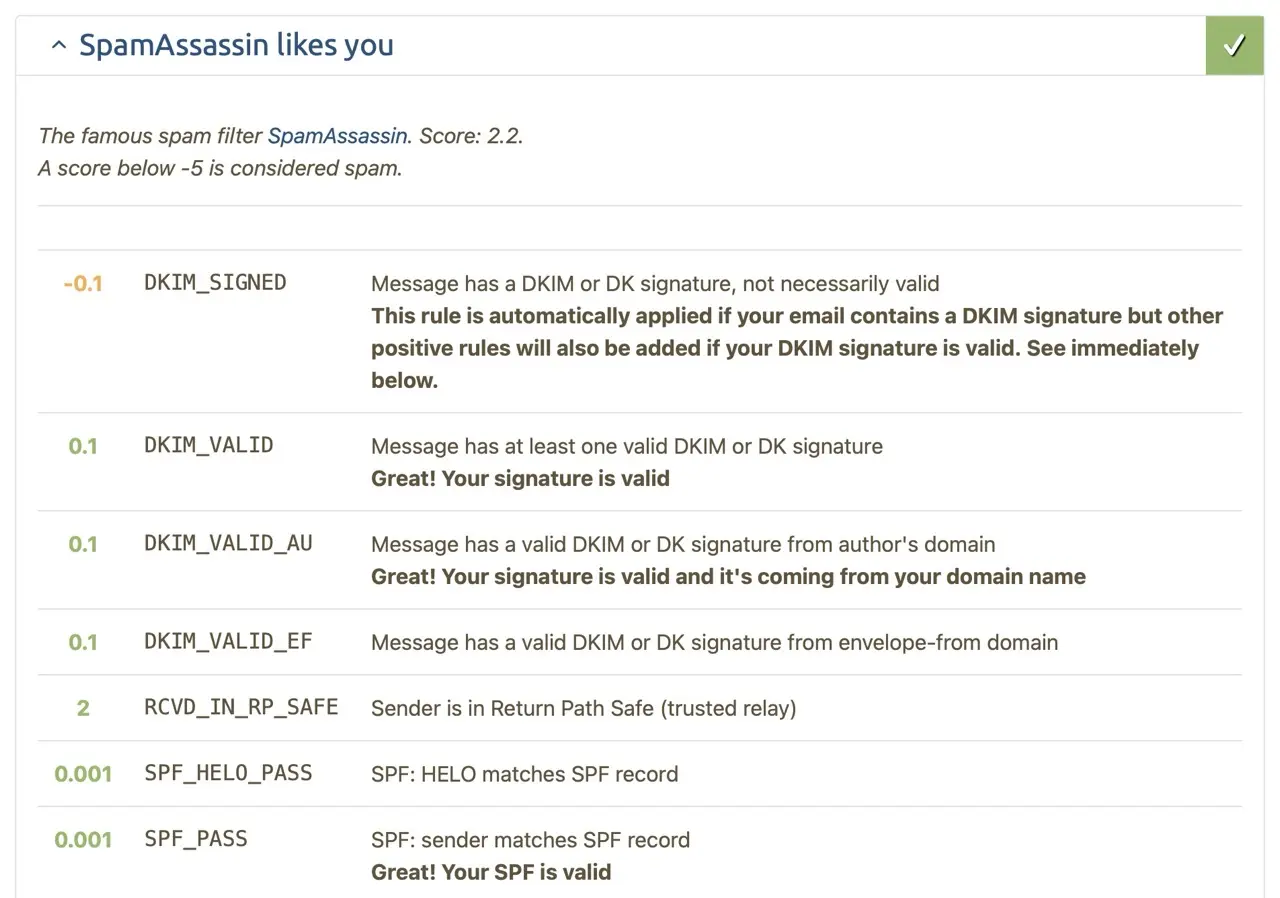
For my main domain, I have an A record pointing mx.idx.cy to my email machine. I also have one extra SPF record just for mx.idx.cy. Without it, SpamAssassin was giving me SPF_HELO_NONE with a tiny penalty of -0.001 points.
| Type | Name | Value |
|---|---|---|
| A | mx.idx.cy | X.X.X.X |
| TXT | mx.idx.cy | v=spf1 a -all |
And for each email domain I have these DNS records:
| Type | Name | Value |
|---|---|---|
| MX | example.com | mx.idx.cy |
| TXT | example.com | v=spf1 mx a -all |
| TXT | key1._domainkey | v=DKIM1; k=rsa; s=email; p=<pubkey> |
| TXT | _dmarc | v=DMARC1; p=reject; rua=mailto:postmaster@idx.cy |
Reverse DNS
Reverse DNS (PTR record) will boost the reputation of your email server. The thing is that your ISP has to set it up, so you need to contact them.
My email was delivered to Gmail just fine, even without the PTR record. GMX and Outlook also didn't mark my mail as spam (and I never clicked "mark as not spam" there).
I measured my reputation with mail-tester and got a 10/10 score. At first I got RDNS_NONE (-1.274 points), but this was solved by the ISP adding the PTR record. I'm also not on any blocklists, yet!
Sending to Gmail
To test the setup, I sent a simple mail to Gmail.
sendmail -t <<EOF
From: max@idx.cy
To: myaddress@gmail.com
Subject: DKIM test
Test message from idx.cy!
EOF
I got the mail instantly and Gmail confirmed TLS encryption.
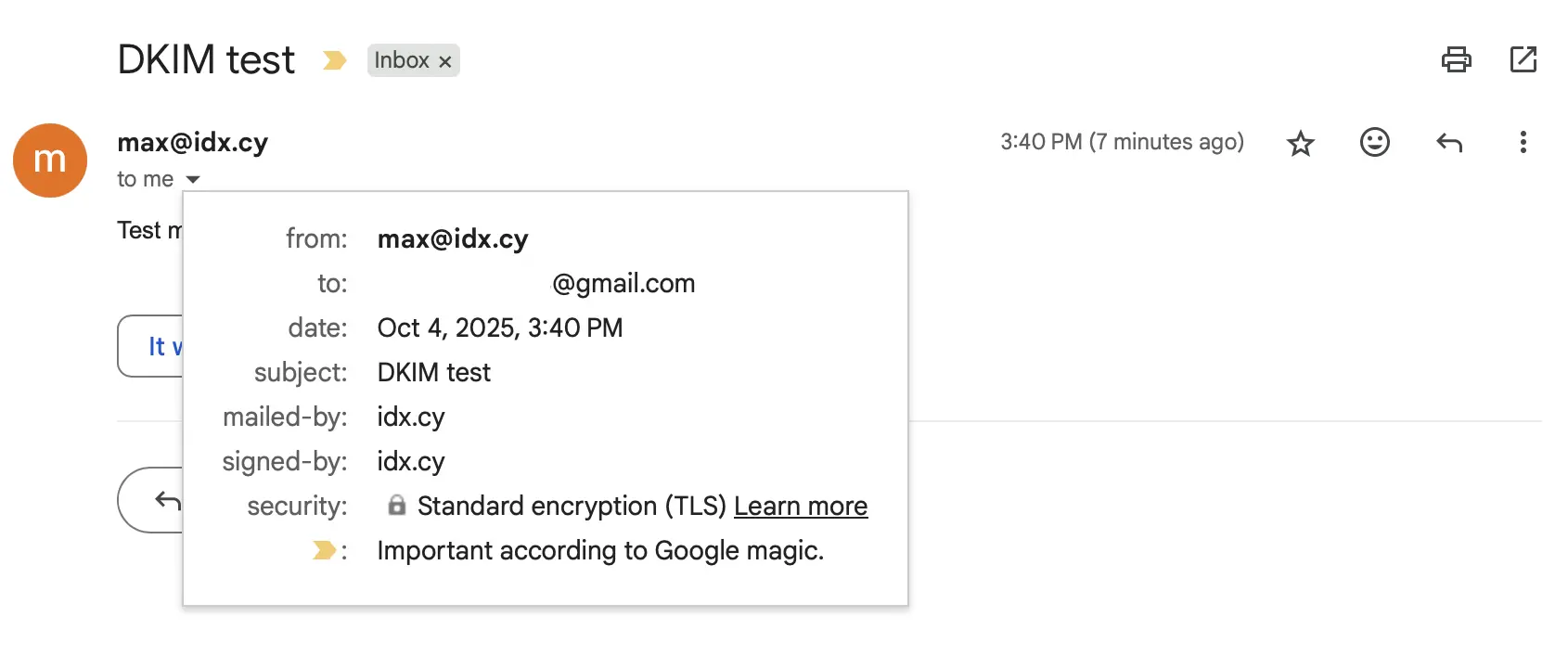
Click "Show original" in Gmail to see the raw mail and check that SPF, DKIM, and DMARC pass.

If you see failures here, double-check your DNS records and your DKIM config, especially check that DKIM keys are readable by the OpenDKIM user.
Receiving mail
I get a notification on the command-line when I receive mail, and I use the print command in s-nail to read mail. I can also reply with the reply command.
You have mail in /var/mail/max
fool ~ | mail
s-nail version v14.9.25.  Type `?' for help
/var/mail/max: 1 message 1 new
▸N  1 Max Adamski        2025-10-06 12:16   63/3716  Test mail
? print 1
[-- Message  1 -- 63 lines, 3716 bytes --]:
From: Max Adamski <myaddress@gmail.com>
Subject: Test mail
Message-Id: <EAA6733B-B946-4B3B-85F7-D1213BC97F0C@gmail.com>
Date: Mon, 6 Oct 2025 12:16:10 +0200
To: max@idx.cy

Hello from Gmail!
s-nail is an amazing CLI client for interactive mail. It's a modern drop-in replacement to mailx. It prints the mail in a very readable format and supports automatically replying in your favorite $EDITOR.
~/.mailrc
set v15-compat

set from="Max Adamski <max@idx.cy>"
set reply-in-same-charset
set fullnames
set sendwait
set hold
set noquote
set record=sent.mail

# always compose in editor
set editalong
# always print in pager
set crt=0
Next steps
- Send and receive mail with Python (batteries included)
- Support mail clients with SMTP remote submission, and POP3 or IMAP